Access to finance is the biggest challenge to entrepreneurs in Africa
By Ben on June 17, 2011
This past week I conducted a poll with members on VC4Africa. Specifically, I wanted to know what the community feels prevents (more) entrepreneurship on the continent. Is it the entrepreneurs, tough business models, lack of exits, the government, corruption or a lack of capital?
Akinyele Aluko, one of the respondents writes from the University of Calabar in Nigeria,’The hardest is getting funds for a start-up, however, other attendant problems are lack of ideas because our R&D system is very poor so innovation is limited. Corruption is another serious problem as well as lack of sincerity by our government.’ Fred Oduke, from the Makerere University in Uganda, expands, ‘It’s hard to get investors ready to invest in new ideas or emerging businesses. As well, we have a very hostile business environment, where government, being the biggest buyer, is deeply tipped in corruption and only those connected can access government contracts. However, it is not all doom, as democracy takes root, opportunities beckon those investing in new ideas and especially pro-poor targeted enterprises; 90% of African are poor, yet they are consumers. Pro-poor business ideas are bound to pay most, especially where ICT is the driver.’
Putting more emphasis on the role of corruption and government, Fidel Buchi Anyi writes from Lagos, Nigeria, ‘Corruption is the greatest impediment to entrepreneurship in Africa! It is corruption that drives poor and inconsistent government policies, volatile political environment, sit-tight rulership, non-access to project financing, multiple taxation, etc. Remove corruption and the business environment will be cleared up to allow brilliant ideas to thrive. Fair competition and honest productive collaboration can only flourish in an environment where corruption is treated with disdain and trust can grow.’ Oliver Wassmann, from the Technische Universiteit Berlijn, shifts the focus again when he writes about the need for better education. He says, ‘The one and single most important issue in Africa is lack of education. And when I say lack of education, I mean lack of knowledge and lack of good values! Education drives the behaviour of human beings. How often did I meet really motivated people with brilliant ideas who miserably failed to live up to their promises? Pointing the finger to government and corruption from my point of view is too simplistic. Corruption flourishes all over the world, also in countries like the US and Germany, yet they are still prospering.’ Clearly all of these challenges play a role in putting together the right ecosystem businesses need to thrive. But which factor stands out heads above the rest?
Not surprisingly ‘Hard to access finance’ is ranked as the number one factor hindering entrepreneurs today. So why does the community cite this as the number one challenge? Is it because the entrepreneurs have bad ideas unworthy of investment? I don’t buy this as many of the ideas we see on VC4Africa are not only important they are actually essential – serving a basic life need in critical sectors like agriculture, health or housing. I wish I could say the business plans I read in other parts of the world were as relevant! So the ideas don’t seem to be part of the problem to me, even if we need different business models and some creative implementation needed to execute them successfully.
So what does ‘Hard to access capital’ actually mean? Is it hard to find money for businesses? Is this to say there is no/little money available or instead that there is money but for some reason it is hard to move? And in this case is it because the entrepreneur lacks the skills, network, model and circumstance needed to make an investment worthwhile or does the money get stuck because the broader political, economic and social context don’t make sense? The infrastructure doesn’t effectively facilitate investment or the money simply doesn’t see the market developments needed to offer viable exits down the road? Again, all of these pieces play a role.
That said, investment capital is seriously required by thousands if not millions of entrepreneurs building businesses across the continent. And I strongly believe there is always money for a good idea in a growing market. In furthering this discussion I reach out to the community again and ask the same question from a different perspective, ‘What is the hardest part about investing in Africa?’ Share your thoughts and help spread the word.
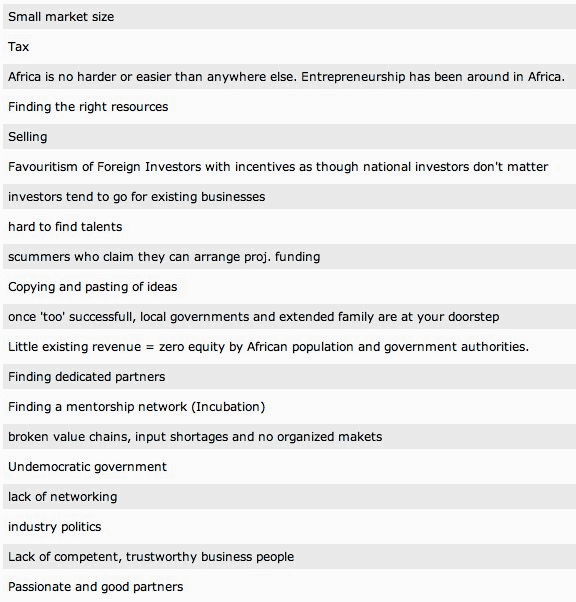
See some of the other comments made by respondents:
Related Articles
You want change? Time to focus on Africa’s entrepreneurs
Rick Harington’s MarketFleas secures funding
Press Release: VC4Africa matches entrepreneurs and investors in Africa


afribiz said on July 5, 2011
While lack of funding is an issue for SMEs everywhere, I think there needs to be discussion on how to bootstrap your enterprise and business model so that we as entrepreneurs don’t get caught in the cycle of what we can’t do, but what we can do.
In particular, we need to take a look at other assets we have, e..g, networks, resources, etc. that can be tapped without cash.
If you can operate your organization on 10% of what others can operate successfully, you will find that you have developed a lean, competitive model. I have seen too many organizations with great business ideas and start-up cash fail because they thought having enough money would make all the difference. They wasted too much of the money and had too much overhead.
It’s important not to fall into the trap of always needing more money. Its true that financial means is needed but as SMEs we often have distorted views of what funding we need when another opportunity to help us go to the next level might be sitting right in front of us.
This has been my experience and continues to be. (-:
Elma Frank said on July 12, 2011
there is need for financial institution to be more entrepreneurial on their way of doing things to help this group of SMEs in Africa. most of them they base on coperate clients at uburn areas and left the majorit of SMEs at rural areas. they also use cillateral as decurity to the loan, while majority of SMEs they dont have especial woman entrepreneurs. the loan process take long hence it does not match with the business plan schedule of the entrepreneurs.
for the business development service they need to take their part in providing business knowledge to SMEs. When doing so they has to consider the language they use, time frame, and price of their products
we need to encourage entrepreneurs on networking where by they can get access to information of skills needed, markets for their products, the best technology to use etc
ideationstation said on August 9, 2011
I firmly believe that corruption, education and other identified bottlenecks do play a significant role in the difficultly one meets in being a sustainable entrepreneur in Africa. Lack of is however given to prominent a position, I have found that the value proposition of many entrepreneurs’ needs to be further developed. Micro financiers and banks are too academic about business plan and its purpose in the raising of capital be it debt, equity or a combination of both. A realisation has to be made that the accounting and finance textbook that we read are not geared at an environment with extremes such as many African countries have.
African entrepreneurs are also to ready to die with their business ideas than share ownership with a financial investor, financial investors on the other hand are not innovating by offering a debt/equity combination that ensure sufficient motivation of the entrepreneur while securing the investors interest. These factors are applicable in $500 investment as they are in a $2 million investment. Education has to be practical yet we see these problems even in more learned parts of the continent.
David Amakobe said on November 30, 2011
There is a real Estate boom in Kenya and in most African countries, meaning money is chasing after land and houses! Financial institutions are structured to lent against physical assets. These are unproductive ways of allocating resources.
Developed countries did not reach where they are by owing large tracks of unproductive land for speculation nor did they ask for title deeds to encourage entrepreneurship.
The Challenge Africa has is that the people with money need, “Education” on seeding ideas from those with ideas with money, and society in general need to respect intellectual property. Banks per say do not finance “Risky” ventures but they should at least allocate 20% of their portfolio away from asset based lending to future income.
If you are reading this, you are in the right place! People who can put there “names” on ideas backed by a little funding and alot of mentoring are the ones who will solve the riddle, and vc4africa seems to be the marketplace to find mentors, ideas and seed funding sources.
I was looking at FORBES List for Africa and thinking may be VC4Africa need to have an outreach education program for investors on investing in local ideas, just a thought!
One last thought, if you are a member of VC$Africa and you are mentored, funded and you are successful – You must mentor, invest in VC4Africa,you should promise.
Joachim Ewechu said on March 5, 2012
At the end of the day, i still believe Africa’s problems can only be solved through entrepreneurship. It is great we are all paying alot of attention to it.
All the problems affecting entrepreneurship can be solved through one major concept, building an ecosystem.
Capital exists, there are very many capital partners willing to put their money down, this is not a problem but the major problem is with the ideas themselves. They are great but we have to turn them into viable businesses, and this is what the ecosystemis meant to do. TO develop adequate business models around these ideas and startups and link them up greatly. I have built a company based on this and it works, it s about knowing the right people, bringing the together for the right cause and this is what the ecosystem is meant to do.
The other problems like corruption and all those other people related problems can all be sorted with the ecosystem. With the ecosystem, you have a voice that can fight all those other small people like corrupt officials because you have powerful entrepreneurs and networks as part of that ecosystem.
At the end of the day still, i think it is with developing adequate ecosystems that are ready to unite entrepreneurs, mentors and various capital partners…Bring them together to create effective change in the political, economic, social and economic situations that we have around us in Africa.